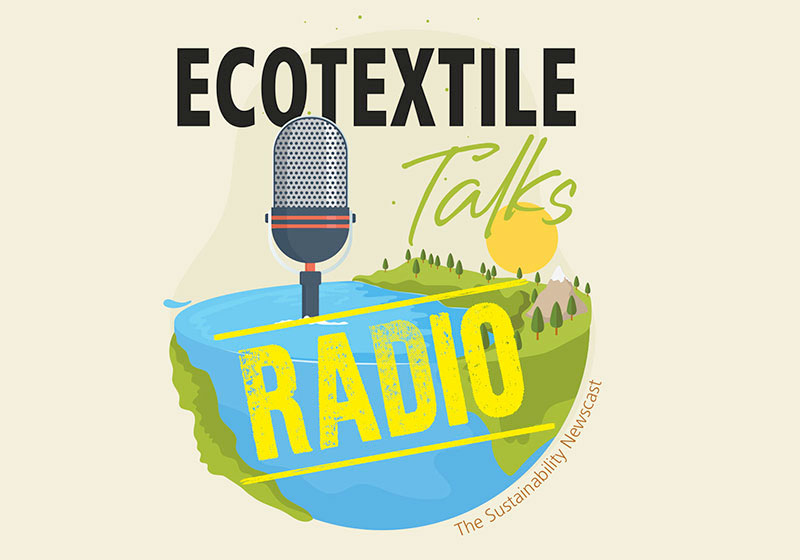
WAKEFIELD – In our latest Ecotextile Talks podcast, Alexa Raab, the global brand and communications manager for bio-materials with US chemicals giant DuPont, explains how the company’s partially bio-based Sorona PTT helps to lower carbon emissions and improve both circularity and transparency in textile supply chains.
And she tells our host, Philip Berman, how the company has introduced two complementary systems – the Common Thread Certification programme and its Preferred Mill Network – to increase transparency and traceability for both brands and end consumers.
Raab explains how and why Sorona is PPT made from 37 per cent plant-based materials and says that from harvesting to production, the bio-polymer manufacturing process uses less energy and releases fewer greenhouse gas (GHG) emissions than conventional synthetics such as nylon.
[sc_embed_player_template1 fileurl=https://traffic.libsyn.com/ecotextiletalks/DupontSorona1404.mp3]
DuPont uses corn starch for its bio-based content which is combined with proprietary enzymes to form a polymer chip which its mill partners spin into fibre, ultimately to make garments and other applications. This, Raab says, results in the fibre offering exceptional stretch and recovery that can also be used as an alternative to elastane while its softness, especially when blended with products like Lenzing’s Tencel, offers retailers another strong selling point.
However, it wanted to reassure both brands and the end consumer that they were getting what they paid for and so launched the Common Thread Certification and Preferred Mill Network programmes.
The former involves the testing of samples to guarantee the content percentage of Sorona in a fabric, as well as its performance.
The Preferred Mill Network is how the company connects brands with a choice of around 350 mills which have undergone stringent tests and are licensed to use the Dupont Sorona trademark.
Raab explained how the schemes benefited Dupont, its partner mills and brands, as well as protecting the end consumer from false marketing claims.
“Each stakeholder in the supply chain has a unique interest but I think the one thing that is common is that everybody wants to be more transparent and more traceable,” she tells Berman.
“I think the thing that’s exciting for me is … all of us working together and saying we all believe that there is value in ultimately being transparent with the customer, and with the end consumer, and this is all the work that we are doing to ensure that the claims that we are making are accurate.
“I think that’s something that I’m very cognisant of, and it might be because of the role that I’m in, but I’m very sensitive of the potential for green washing.”
Subscribe to our podcasts and radio shows by following us on Apple, Google, Spotify and Amazon Music, to automatically get alerts when we launch a new Ecotextile Talks Behind the News podcast.