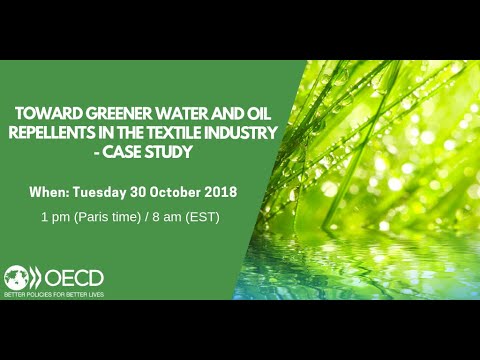
This OECD webinar features a case study from the Mid-War Life Project and explores ways to mitigate the environmental, health, and safety impacts of durable water and oil repellents (DWORs) used in the textile industry. The project assessed both traditional and alternative DWORs, aiming to reduce emissions and exposure to toxic compounds.
Key topics covered in the webinar:
• Project Objectives and Methodology: An overview of the project’s goals, technical screening of new technologies, and the selection of 14 DWORs for testing on five different fabrics. The project included lab and industrial scale testing.
• Technical Results: Discussion of the performance of various DWORs including fluorinated and non-fluorinated alternatives, focusing on water and oil repellency grades, and washing fastness. The project used the water repellent or spray test, and the oil repellency test as a main part of the characterization of the fabrics after treatment with the different DWORs.
• Environmental Impact Assessment: A life cycle assessment (LCA) was performed to evaluate the environmental impact of six different DWORs, from raw material extraction to disposal. The LCA considered various impact categories including toxicity and climate change. The study used primary data from the industrialization process.
• Occupational Risk Assessment: Analysis of the occupational health risks associated with conventional and alternative DWORs. The project had to overcome the challenge that the chemical identity of substances in a formulation is not always disclosed. The assessment included hazard identification, exposure determination, and risk ranking.
• Policy Recommendations: The webinar presents recommendations for chemical substitution policies that favor fluorine-free alternatives, while acknowledging some critical uses for fluorinated products that require further research and development. The Mid-War project also analysed how DWOR products relate to obtaining the European Ecolabel.
• Best Available Techniques (BAT): Recommendations for the future provision of reference documents on best available techniques for the textile sector are also presented.
Key Takeaways for the Textile Industry:
• Understanding the environmental and health impacts of different DWORs.
• Identifying viable non-fluorinated alternatives for water repellency.
• Exploring options for reducing the use of fluorinated substances while maintaining performance.
• Implementing safer practices for handling DWORs in the workplace.
• Complying with European Ecolabel criteria and future regulations.
The webinar recording is available on the OECD Chemical Safety and Biosafety YouTube channel.