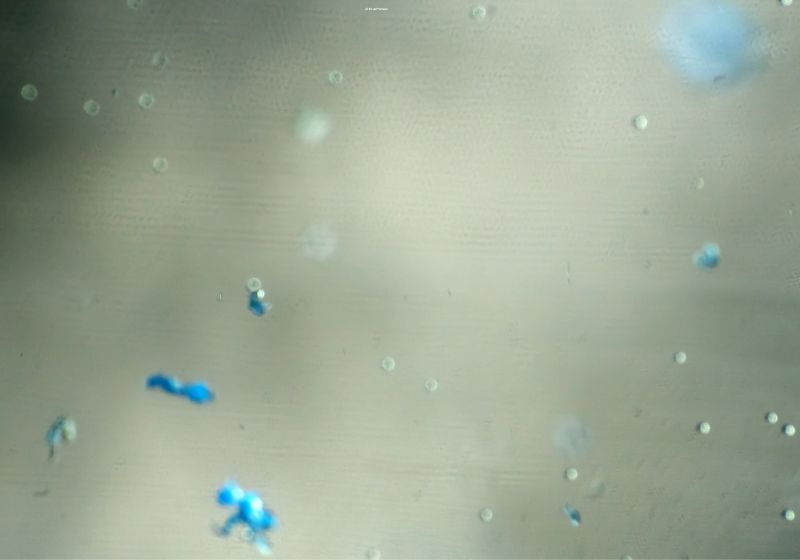
New Nike-funded research proposes a new way to more accurately measure and control the amount of microparticles found in textile wastewater.
The research hoped to address the problem of comparing microparticle data from different studies, due to a lack of standardisation when measuring particle quantities – especially those below 20 μm, which make up most microparticles in the environment.
To do this, a new method is proposed that counts microscopic fibre fragments, debris and microorganisms at one of Nike’s Asian textile suppliers in partnership with TUV-SUD in Singapore. 
Rather than using conventional methods to assess microparticle contamination in textile wastewater discharge, such as the test ASTM D8332-20, a commercially available laser counter used in the semiconductor industry to measure particulate contamination in slurries was employed, because it counts particles as small as 2 μm.
“Current measurement approaches do not measure smaller particles, and are highly prone to contamination, and lack standardisation,” said the researchers in a paper on ResearchGate (see link below).
After primary treatment of textile wastewater, the Nike supplier, which dyes and finishes cotton and polyester fabrics, treated onsite wastewater with a clarifier in parallel with a membrane bioreactor (MBR).
Samples downstream of the clarifier and MBR were collected and analysed before and after flowing through a hollow fibre ultrafiltration module with nominal pore size of less than 0.03 μm.
The ultrafiltration module removed in excess of 99% of the particles of all types between 2 and 35 μm, and 100% of particles between 35 and 125 μm in diameter.
The researchers said, “considering that many textile mills manufacture hundreds or thousands of square metres of fabric per day, creating thousands of tons of wastewater in the process, it’s likely that previous studies attempting to quantify microparticle discharges into the environment have significantly underestimated the particle counts, especially since most of those studies focused only on microplastics, did not consider natural fabrics, and did not count particles below 20 μm in diameter.”
Outcomes
The research suggested that moving away from current mass-based metrics [total suspended solids (TSS) and total solids (TS)] to using micro-particle counts per millilitre (#/mL) would better align microparticle tracking and help to assess their impacts on the environment and the food chain.
Treated effluent from an MBR contains significantly fewer microparticles than a traditional up-flow clarifier used to treat textile wastewater.
Ultrafiltration downstream of the MBR or clarifier in a wastewater treatment system should be considered to prevent the release of nearly all the microparticles from a textile mill.
“Implementation of this approach throughout textile manufacturing provides an opportunity to significantly reduce the amount of microparticles that end up in water and eventually in the ocean,” the authors concluded.
The research paper is available to download here.