DHAKA – A decade after the garment industry’s worst ever disaster, Ecotextile News pays tribute to the victims – and survivors – of Rana Plaza with a 13-page special supplement in the latest issue of our magazine and a commemorative podcast episode of Ecotextile Talks.
Download our special supplement HERE and listen to our podcast episode Perspectives on Rana Plaza HERE.
An official total of 1,132 people were killed and at least 2,500 injured when the eight-story commercial building, containing several garment factories, collapsed due to structural faults on 24th April 2013.
Our special section asks what – if anything – has changed since that day through a series of interviews in Dhaka with industry stakeholders, unions and the victims and survivors of Rana Plaza whose voices are not often heard.
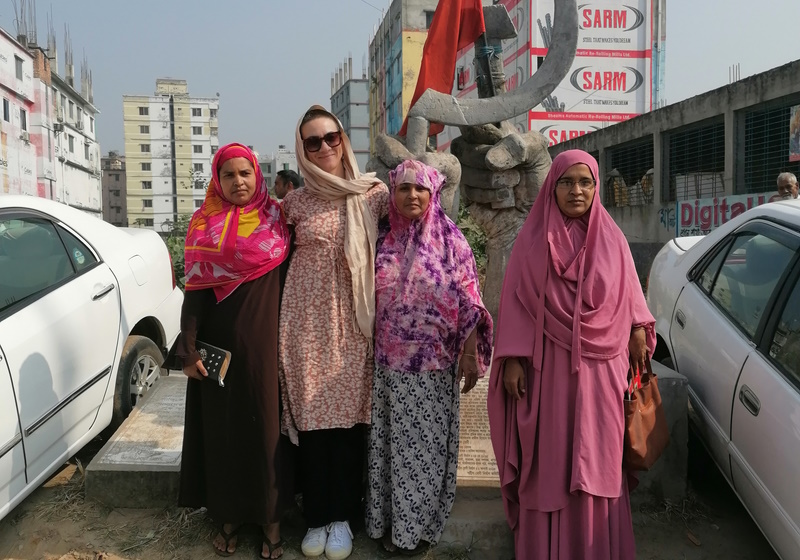
In a poignant meeting with orphans and survivors on the site of the disaster, our correspondent Lavinia Muth – an experienced factory auditor – heard how many people caught up in the disaster still felt abandoned by the government, the garment industry, and by the retailers and brands which still source from the country.
“The garment buyers have done an un-justice to us. We didn’t get proper justice, relief or compensation as we still cannot work,” a group of disaster victims told us at the Rana Plaza memorial, not far from the building location.
Our coverage also includes an interview with Professor Rashedur Chowdhury, from the University of Essex, who grew up in Bangladesh and has conducted more than 400 interviews with those impacted by the disaster.
He suggest that, if avoiding vast compensation pay-outs was the goal of companies sourcing from Bangladesh, this has been frequently achieved. Many brands were eager to become signatories of safety agreements in the wake of the tragedy to “cool down the outcry about compensation”, he claims.
Other stakeholders however report some progress on issues such as building safety and unionisation over the last 10 years in the Bangladesh garment industry.
Khadiza Akter, of the Awaj Foundation and vice president of Sommolito Garments Sramik Federation, who started her career as a child worker in the garment sector when she was 11 years old, told us: “Before Rana Plaza there were hardly any unions, and factory owners were not aware of building safety issues.
“Since then, we have seen safety increase in every factory and buildings are checked for problems. Right after the incident, however, there was still an unwritten direction from the government not to allow union registration.”
Several other Bangladesh unions claimed there was still a significant ‘imbalance in power’ between workers, factory owners, and the brands – heavily skewed in favour of the owners and buyers.
This goes some way to explaining the subsequent growth in garment worker unionisation – and militancy – over the past decade in an industry where the average salary is still only around US$100 per month for 11 hour shifts.