The symptoms are visible across roadmaps, capsule collections and ESG dashboards. The industry is investing aggressively in next-generation fibres while leaving behind the very machines that manufacture them. It is privileging optics over operations, storytelling over systems.
This fractured approach has created a pathway that is financially brittle, operationally fragmented, and environmentally insufficient. Bio-based, regenerative, and recycled fibres have become the face of climate narratives. They are tactile, narratable, and easy to market. They feature prominently on hangtags and in investor decks because their appeal lies in simplicity: change the input, and the output will follow. Yet this logic is seductively misleading.
Fibres may command visibility, but emissions remain embedded in the core. The true drivers of impact are hidden in boilers, dyehouses, dryers, chemical auxiliaries and legacy infrastructure.
These midstream systems account for the bulk of emissions yet remain underfunded, not due to ignorance but because of broken incentives. Brands do not own this infrastructure. If they fund new equipment, the benefits accrue to competitors as well. With no clear claim to ownership or exclusivity, investment stalls.
By contrast, fibres provide full control. A brand can choose a fibre, market the narrative, and claim the impact. This makes fibre adoption attractive, but also incomplete. A bio-based yarn processed in a fossil-fuelled facility undermines its own premise. A recycled fibre dyed with outdated chemistry introduces contradictions. The industry risks performing sustainability rather than achieving it.
The double dividend protocol is designed to restore coherence
The double dividend protocol is designed to restore coherence. It is not a material or a machine. It is a financial architecture that redirects operational savings from supplier decarbonisation into fibre procurement. By doing so, it creates a system that lowers emissions, funds next-generation fibres and transfers the return on investment from the weakest point in the chain to the place where economic leverage is strongest: the brands.
Today’s sustainability strategies unfold on parallel tracks. Suppliers chase energy efficiency when financing is available, while brands pursue fibre substitution to meet consumer-facing targets. Neither pathway achieves enough on its own, and their separation undermines progress.
Suppliers operate on razor-thin margins. Even when high-efficiency boilers, electric heat pumps, or automated dosing systems promise clear savings, the upfront capital is prohibitive. Loans are difficult to secure, and repayment risk is high. Upgrades stall not because the technology is unproven, but because the savings accrue to suppliers with the least capacity to reinvest.
Fibres face the same problem
Next-generation fibres face a mirror image of the same problem. Innovators can demonstrate reduced environmental impact, but their materials remain priced 50 to 200 percent higher than conventional alternatives. Brands are reluctant to lock into offtake agreements at these premiums. Without predictable demand, innovators cannot scale; without scale, prices never fall.
This bifurcation leaves the industry in stasis. Suppliers delay upgrades they cannot finance. Brands avoid premiums they cannot justify. Innovators remain stuck in pilot scale. The system is not short on solutions; it is short on sequencing.
The double dividend protocol resolves this sequencing failure. It proposes that brands fund supplier decarbonisation upgrades, with the resulting operational savings contractually redirected into the procurement of next-generation fibres.
The result is a ‘double dividend’ – emissions reductions and material transformation, both unlocked through one financial architecture
Rather than treating decarbonisation and fibre adoption as separate struggles, the protocol links them in a single economic loop. Upgrades reduce energy and water costs. Verified savings are earmarked for fibre procurement. Brands gain access to cleaner materials at cost parity. Suppliers modernise infrastructure without carrying debt. Innovators benefit from predictable demand driven by structural economics rather than speculative commitments.
The result is a ‘double dividend’ – emissions reductions and material transformation, both unlocked through one financial architecture.
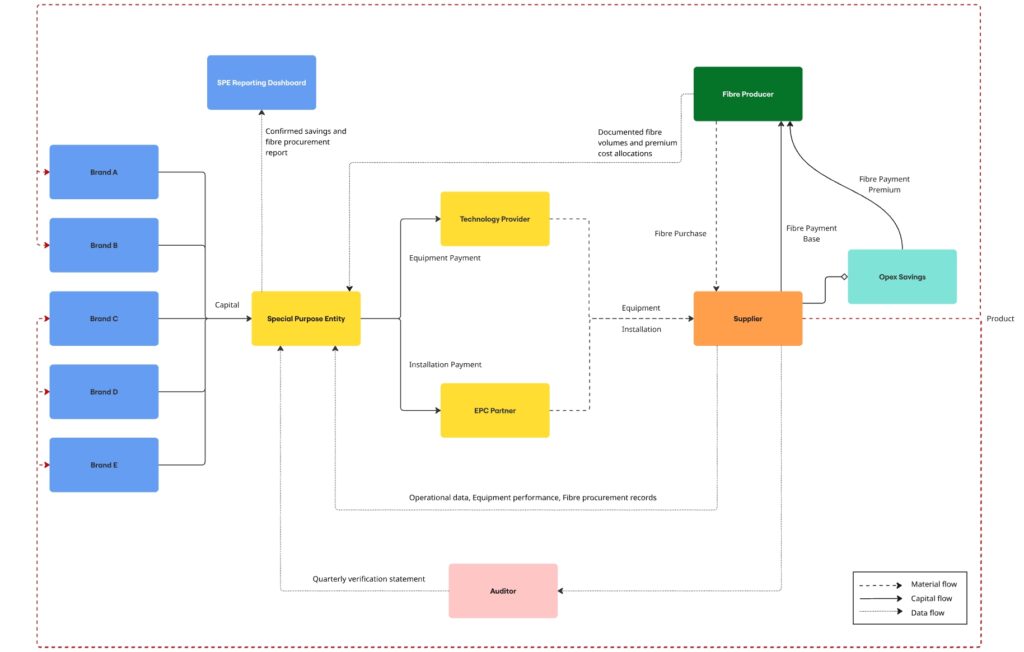
Consider a vertically integrated supplier in Asia processing three million kilograms of conventional fibres annually. Its operations depend on fossil boilers, high-liquor dyeing, and manual chemical dosing. The facility is emissions-intensive and operating on thin margins. It supplies three brands:
- brand A accounts for 40% of the volume
- brand B accounts for 35%
- brand C accounts for 25%
Each brand wishes to scale next-generation fibres, but the market price is 50 to 100% higher than conventional fibres. The volume is insufficient, and none of the brands can absorb the premium at scale.
The supplier has identified a decarbonisation pathway: heat pumps, low-liquor dyeing, automated dosing. Capital expenditure required: $4 million. Projected annual savings: $1 million.
But no one moves. The supplier cannot risk the capital. Brands hesitate because the benefits are diffuse. Investment stalls.
The double dividend protocol reframes the problem. The three brands jointly fund the upgrades in proportion to their production share:
- brand A invests $1.6 million
- band B invests $1.4 million
- brand C invests $1 million
Once upgrades are complete, the supplier generates $1 million annually in operational savings. These savings are contractually earmarked for fibre procurement. At a premium of $1 per kilogram, the facility can now access 1,000,000 kilograms of next-gen fibre each year without raising its net cost base.
Fibre is distributed proportionally:
- brand A secures 400,000 kilograms
- brand B secures 350,000 kilograms
- brand C secures 250,000 kilograms
No premium is paid. No risky offtake agreements are required. No pooled procurement schemes are necessary. Fibre enters the system through the back door of operational savings, not the front door of consumer surcharges.
This architecture also corrects a deeper flaw: where return on investment sits in the value chain.
This architecture also corrects a deeper flaw: where return on investment sits in the value chain. Today, ROI remains with suppliers who have the least leverage. A boiler upgrade may save them hundreds of thousands annually, but those savings rarely fuel systemic transformation. Suppliers cannot carry the burden of decarbonisation while operating on margins of just a few percent.
The double dividend protocol moves ROI upstream. By funding upgrades, brands capture the dividend. Verified savings are contractually allocated to cover fibre premiums. This transfers the yield from suppliers to brands, who have both the economic leverage and the marketing incentive to scale impact.
This shift matters because fibre premiums are not disappearing anytime soon. Recycled and regenerative materials face structural cost barriers. Venture capital and philanthropy may bridge early volumes, but at industrial scale, premiums will persist. Brands face a recurring bill for every kilogram of fibre they source.
The protocol reframes this recurring cost as a dividend bearing investment. Instead of paying a premium over a long period, brands make an upfront outlay that generates yearly savings to cover fibre premiums. Once the initial investment is recouped, often within three to five years, the benefits continue. Fibre remains accessible at parity, emissions reductions are locked in, and the return compounds over time.
For brands, this turns sustainability from a long term surcharge into a capital asset. The logic is no longer about spending more but about spending differently.
At scale, the implications are significant. If 500 factories across South and Southeast Asia adopted the protocol, annual savings could exceed hundreds of millions of dollars. If all the savings are redirected into fibre procurement, the next-gen fibre market would expand dramatically, pushing innovators to scale and narrowing the cost gap.
For investors, the model creates blended finance opportunities. For regulators, it delivers emissions reductions without subsidies or taxes. For suppliers, it modernises infrastructure without debt and secures more efficient operations. For consumers, it ensures access to sustainable products without cost penalty. For innovators, it establishes predictable demand that supports long-term growth. For brands, it provides next generation fibres at parity, delivering better fibres processed in modernised factories and creating the leap in sustainability they have long sought.
The double dividend protocol is not a silver bullet but a structural reordering of how the industry finances its transition. It links the hidden economics of decarbonisation with the visible demand for sustainable fibres, turning capital expenditure into a recurring source of fibre affordability. It shifts return on investment from suppliers to brands, where leverage and incentives align, and converts recurring premiums into compounding returns.
The protocol does not ask the industry to spend more, only to spend differently. What it needs now are the first hands willing to shape it into practice.
For further insight, please take a look at a brand new Substack piece from Shivam which sets of this framework in a structured article describing how it could work in practice.