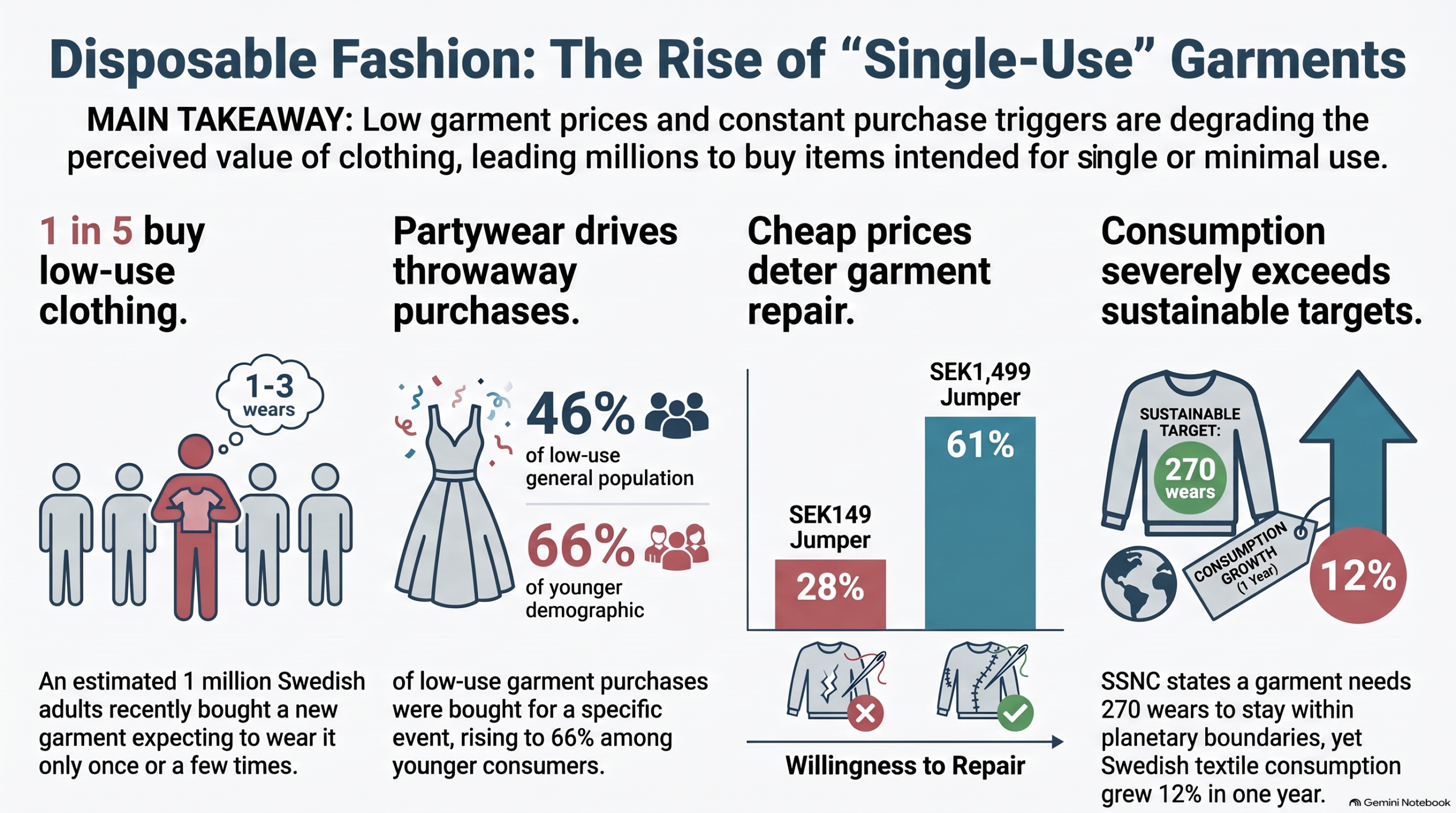
One in five Swedes has bought clothing in the past three months despite expecting to wear it only a few times, according to research by the Swedish Society for Nature Conservation with Beteendelabbet and Verian.
The survey of 1,061 people aged 18 to 84 found nearly four in 10 buy newly produced garments at least every three months. Researchers estimated the low-use purchases represent around one million adults.
One in five Swedes has bought clothing in the past three months despite expecting to wear it only a few times, according to research by the Swedish Society for Nature Conservation with Beteendelabbet and Verian.
The survey of 1,061 people aged 18 to 84 found nearly four in 10 buy newly produced garments at least every three months. Researchers estimated the low-use purchases represent around one million adults.
Party and celebration outfits were the most common reason, cited by 46% of those making such purchases. Among younger respondents, the share rose to 66%.
“Sometimes it is actually possible to talk about single-use garments,” said Beatrice Rindevall, chair of the Swedish Society for Nature Conservation.
The organisation said low prices, rapid trend cycles and social-media “purchase triggers” encourage impulsive buying. It called for stricter regulation of what it described as unsustainable fast-fashion business models.
“Today’s clothing industry with fast fashion and ultra-fast fashion exploits the fact that we find it difficult to resist purchase impulses in the moment,” Rindevall said.