Unlocking substantial savings with AVITERA® SE GENERATION NEXT
Balancing consumer demand for vibrant, long-lasting colours with the urgent need to both cut costs and reduce environmental impact is fast becoming the defining challenge that will separate the leaders from the laggards in the fashion and textile industry.
Always-popular dark shades – like black, navy, and red – present a particular conundrum. Achieving deep, uniform colour has traditionally been one of the most resource-intensive steps in textile dyeing: requiring high dye concentrations, more water and energy.
These challenges don’t just drive-up production costs, they also lead to significant waste when colour quality falls short. That’s why garment savings are increasingly defined not just by lower costs, but by reduced rework, less waste, and more efficient, high-quality output.
Archroma’s AVITERA® SE GENERATION NEXT dyes are designed to address these very issues.
The fourth generation of Archroma’s revolutionary AVITERA® SE range of high-fixation cellulosic dyes, GENERATION NEXT enables mills to achieve rich, dark, and extra-dark shades with the same cost-competitiveness as pale and medium tones. How? By reducing recipe costs, cutting resource consumption, and consistently delivering right-first-time (RFT) results.
Earlier this year, Archroma expanded the GENERATION NEXT palette with AVITERA® RASPBERRY SE, an IP-protected brilliant trichromatic red that empowers mills to achieve rich shades with improved durability in wear and care.
Like the rest of the AVITERA® SE family, GENERATION NEXT is categorised as an IMPACT+ solution within Archroma’s SUPER SYSTEMS+ framework of end-to-end fibre-specific solutions. This means it delivers maximum resource savings, high wash durability, and beyond-compliance chemicals – as compared to standard FOUNDATION processes with ZDHC Gateway MRSL Level 3 compliance.
Case study: Per-garment resource savings
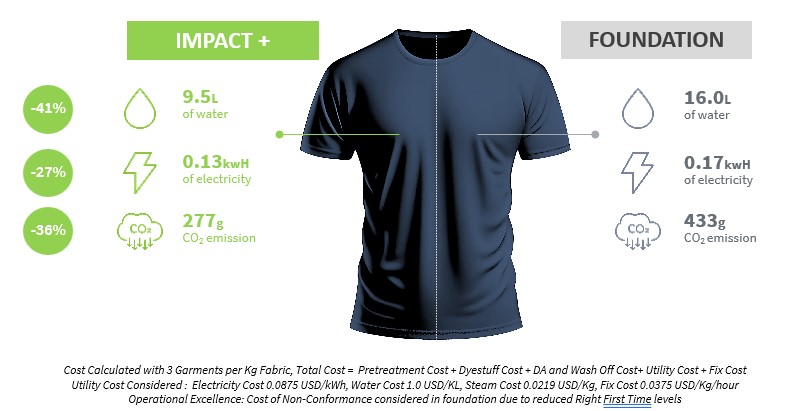
The chart on the below highlights the potential resource savings when upgrading from FOUNDATION-level processes to AVITERA® SE dyes in combination with Archroma’s all-in-one Blue Magic pretreatment to produce a dark-coloured 100% cotton T-shirt:
- 41% water savings
- 27% electricity savings
- 36% CO2 emissions reduction
The example assumes a production rate of three garments per kilogram of fabric, with total garment cost calculated from pretreatment, dyestuff, dyeing auxiliaries and wash-off, utility usage, and fixed costs. The impact of improved RFT performance at IMPACT+ level is reflected in the following plant-level annual savings chart.
Case study: Plant-level annual savings
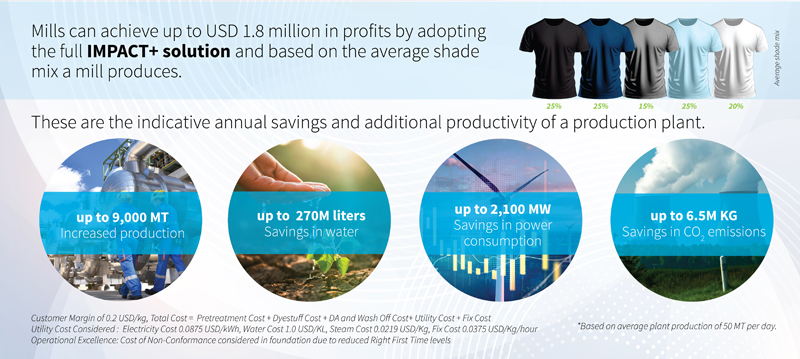
This chart extrapolates the per-garment data to plant level to show indicative annual savings and productivity improvement:
- Up to US$18 million increased profit
- Up to 9,000 metric tons (MT) increased production
- Up to 270 million litres of water savings
The example relates to a plant that produces 50 MT of cotton knits per day in a variety of shades, switching from FOUNDATION to IMPACT+ with AVITERA® SE and Blue Magic. Improved RFT performance reduces the cost of non-conformance by eliminating rework, cutting inefficiencies, and improving final quality.
These results speak for themselves: with AVITERA® SE GENERATION NEXT, mills can unlock new levels of efficiency, profitability, and sustainability—without compromising on colour or quality.