
SPONSORED CONTENT – Taiwan’s textile industry is renowned for its innovation, which will be showcased in the uniforms it creates for international sports events
Taiwan is often referred to as the ‘Tech Island’ due to its technological leadership in various business fields, and Taiwan’s textile industry is no exception.
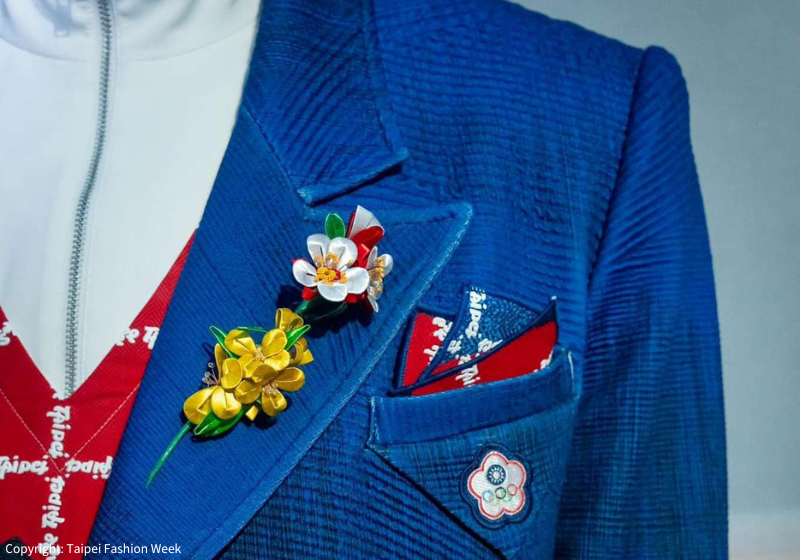
Key players in the Taiwan’s functional textile industry recently proved their technological credentials and strong focus on sustainability in a behind-the-scenes collaboration to create the uniforms for the Chinese Taipei Olympic team participating in the Paris Olympics 2024.
The uniforms were produced in a collaboration between fabric producer New Wide and label producer Junmay. The outer jacket was made with New Wide’s advanced carbon capture yarn and 3D sculptured fabric, complemented with digital direct prints. The design was inspired by Taiwan’s mountain ranges, envisaging their mountain mist merging with oceanic blue tones to create a unique pattern.
Advanced technology for increased comfort
New Wide incorporated advanced technologies to develop the fabric for the polo shirts in the official Olympic uniforms. These included Nano-Ge Nylon, cooling yarn and single-sided mini loop structure. This yarn uses high-tech powder grinding and dispersion technology to implant germanium elements. This releases negative ions that neutralise the body’s positive charge, promoting microcirculation, and reducing fatigue. The tested fabric contains approximately 2,900-3,800 negative ions per cubic centimetre, which exceeds typical levels in urban and green areas.
The cooling yarn absorbs moisture and sweat to ensure the athletes stay cool, comfortable and dry. Meanwhile, the structure of the single-sided mini loop texture provides the light, breathable characteristics of single-sided fabric, without clinging to the body.
The labels were designed by Taiwan’s largest label manufacturer, Junmay, using two sustainable yarns. The first one, Greencell® Filament Yarn, is made from biodegradable raw materials, while the second, Seawool® yarn, is upcycled from discarded oyster shells, and has a wool-like structure and texture.
Creating uniforms for the French Open 2024
The expertise of the Taiwanese textile industry was also used to develop uniforms for the recent French Open 2024 in Paris.
For the staff uniforms for this year’s French Open, functional textile manufacturer Premiere Fashion collaborated with international brands to develop high-quality moisture-wicking knitted fabrics. It quickly absorbs large amounts of sweat, keeping clothing extremely comfortable.
Premiere Fashion develops virous innovative fabrics through its rich professional and technical knowledge, and has established a theme fabric system called MultiOne that divides into six parts: cool & dry, warm, lifeStyle, waterproof, windproof, and protection. “The new technology not only enhanced the comfort of the staff but also reaffirmed the excellence of Taiwan’s textile industry in functional fabrics,” said Michael Lin, general manager for Premiere Fashion.
Taiwan’s textile manufacturers will continue to develop new technology to create uniforms for brands and athletes around the world in adherence with the principles of sustainability and innovation, according to the Taiwan Textile Federation (TTF).
TTF implements the ‘Textile Export Promotion Project’ (TEPP) by selecting premium textile suppliers and promoting their sustainable and innovative products. The project provides customised sourcing service for the overseas buyers to discover new textiles, manufactures, and sustainable solution from Taiwan, and select news of companies, new launches, or technologies that are worth sharing with you.
The TEPP project for more info: https://export.textiles.org.tw/en/index.aspx (Ad. by TITA)