SPONSORED CONTENT – The LYCRA Company and Qore® join forces to create next generation bio-derived LYCRA® fibre with QIRA®
The global apparel industry is responsible for 8% of the world’s greenhouse gas emissions and the industry is mostly reliant on hard coal and natural gas to generate electricity and heat. Without significant changes, the greenhouse gas (GHG) emissions from the industry are expected to rise by almost 50% by 2030.*
However, recent data from the Rodale Institute shows that if farmers can improve soil health, through regenerative agricultural practices, then more than 100% of the global annual CO2 emissions could be sequestered into the soil. That’s roughly 52 gigatonnes of carbon dioxide every year!
The purpose of Regenerative Agriculture is that farmers promote healthy soil practices and biodiversity including low or no tilling, planting cover crops, managing fertilizer use, and improving nutrient management. All of these practices are designed to increase soil organic matter and reduce GHG emissions by sequestering more atmospheric carbon into the soil. This in turn helps promote biodiversity – as well as improving water quality and reducing soil erosion.
In a ground-breaking collaboration, The LYCRA Company has joined forces with Qore®, a joint venture between Cargill, an expert in agricultural fermentation technologies, and HELM, a German chemical company. Next year, Qore® will be producing QIRA® – an ingredient derived from Iowa field corn. QIRA® will be the key component in renewable LYCRA® fibre, bringing the same comfort and fit as from traditional LYCRA® fibre, now with a reduced environmental impact.
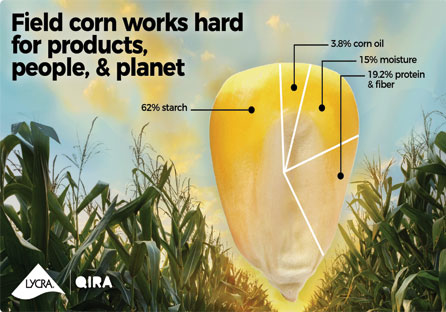
When Cargill receives the harvested corn from the farms, part of the process involves separation of the kernel into discrete parts, ensuring each gets used where it can deliver the most value. For example, while the protein typically gets used to create animal feed, the starch portion can be found in a myriad of applications – including ethanol for gasoline, food uses such as corn syrup, and now, fibres for clothing. Steve Stewart, Chief Brand & Innovation Officer of The LYCRA Company, says “By adopting QIRA®, we’re making a significant commitment to reduce our reliance on fossil-based resources and to enable our customers to reduce their carbon footprints.”

Steve Kuiper (pictured left), whose family has been farming in Iowa for more than a century, speaks to its benefits. “Iowa has some of the most productive farming ground in the nation, excellent infrastructure for transporting goods, and the support of organizations like Iowa Corn Growers Association and Iowa Corn Promotion.”
Iowa is also home to Cargill’s biotechnology campus and corn refining operation in Eddyville, Iowa. The Qore® facility for manufacturing QIRA® is also located here, tapping into Cargill’s expertise, R&D and network of farmers. The Qore® facility will run mainly on wind power, reducing energy GHG emissions, and will source field corn from within a 100 mile radius – reducing transportation emissions and providing local farmers, like Kuiper, with a reliable market for their crops.
To learn more, visit: lycra.com/qira
*United Nations, UN launches drive to highlight environmental cost of staying fashionable, 25 March 2019