KORBA / MOKNINE – As policymakers, brands, and manufacturers prepare for the introduction of Digital Product Passports (DPP), Tunisia’s denim sector provides an early example of how the industry is responding.
UNEP’s InTex project (Innovative Business Practices and Economic Models in the Textile Value Chain) documented a visit to denim manufacturers in Tunisia in May to find out how they are dealing with upcoming changes to regulation.
WATCH: UNEP footage on how the Tunisian denim sector is adapting to the DPP. Edited by Ecotextile News
The DPP requirement for textiles is being finalised under the Ecodesign for Sustainable Products Regulation (ESPR), with a textile-specific delegated act expected in early 2027 and DPP obligations for textiles then phasing in after the usual transition period (commonly about 18 months), meaning products sold on the EU market will need compliant DPPs around 2028–2029, depending on the final timeline and company size.
The passport carries digitised, structured product data such as fibre composition, traceability, care, repair and recycling information. It means products can be tracked, repaired and recycled more easily.
This comes with substantial implications for industries with complex global supply chains, such as apparel. A pair of jeans could pass through multiple suppliers, factories and countries before reaching consumers, involving raw materials, trims, chemicals, water, energy and transport at every stage.
A QR code, or other machine-readable data carrier, applied to the garment would reveal information on sourcing, buttons, rivets, thread, washing treatments and quality-control processes – making it one of the most comprehensive transparency tools yet proposed for consumer products.
From policy to factory floor
“The digital product passport is pushing us to document everything about a garment, from the fibre, the composition, the wash, even traceability about recycling and everything that comes after,” says Alison De Meirsman, creative director of Tunisian denim manufacturer DEMCO.
“The digital product passport is pushing us to document everything about a garment, from the fibre, the composition, the wash, even traceability about recycling and everything that comes after.”
As seen in the video, supermodel and UNEP ambassador Amber Valletta visited Tunisian denim factories to better understand the environmental realities behind manufacturing in the age of upcoming regulation.
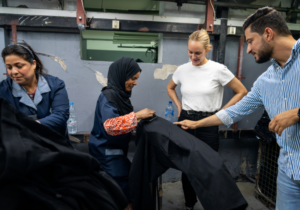
“The complexity of what it takes to make one pair of jeans is mind-blowing,” Valletta says.
“There are hundreds of hands that go into making one pair of jeans.”
Implementation of the passport begins on factory floors. Manufacturers are investing in new systems that not only reduce environmental impacts but also generate the data needed to document product lifecycles.
“The traditional denim activity consumes a lot of water, a lot of energy and produces a lot of environmental impact,” says Bilel Ben Miled, sustainability manager at Gonser Group.
“With new technology and investing in recycling stations, we can reduce more than 75% of water consumption in one piece.”
And as European sustainability requirements evolve, manufacturers supplying the EU market face increasing pressure to demonstrate transparency and environmental performance across operations.
Industry leaders say the changes are being driven by market demand, consumer expectations and regulation.
“The EU policy is shifting the way in which the global system of companies is looking at textiles,” says Sheila Aggarwal-Khan, director of the UN Environment Programme’s industry and economy division.
“Companies are seeing that if they meet certain standards, they enter niche markets which reduce environmental footprints and respond to increasing consumer demand.”
“Companies are seeing that if they meet certain standards, they enter niche markets which reduce environmental footprints and respond to increasing consumer demand.”
In March, the EU Joint Research Centre published a framework for how regulators will define required DPP data elements for textiles.
The landmark step moved the DPP from abstract policy to implementation, yet concerns remained around which categories would be mandated, the burden of back-filing legacy product data, and the uneven capacity across suppliers to provide the detailed information on chemicals and chain of custody implied by the draft rules.
Other countries have also been preparing for the launch of the passport. The USB certification recently signed a Memorandum of Understanding (MoU) for DPP compliance and supply chain traceability alongside Belgium-based digital traceability platform Beyond Bar Code and ISKUR Tekstil, one of Turkey’s most integrated textile manufacturers.
While Ecotextile News reported in June that Vietnam’s government is issuing a challenge to its textile, garment and footwear industries to step up the pace of sustainability and digital adoption.
“The digital product passport offers real opportunities because it allows companies to show the content of their product and trace the composition of products across their lifecycle,” Aggarwal-Khan concluded.
“It is something consumers and buyers are increasingly looking for, especially as they seek more sustainable products in the market.”
The InTex project is funded by the EU and the Danish government, and supports manufacturers in improving environmental performance, traceability and transparency.
InTex helps SME textile enterprises identify opportunities to reduce water use, chemical inputs, waste and greenhouse gas emissions while preparing for evolving market and regulatory requirements.
Image credit: Justin Jin/UN Environment Programme